My Experience with Erector Sets | |
| Hi Lindy
Hoppers!!! Boys Should be Boys! | |
![]() Erector Sets - Feeding the Dreams of Young Boys Do you think they believed that the set would allow them to build something that big? | |
After a whole lot of preparation, I have finally finished this page on Erector Sets. This has been one of my continuing interests from childhood through my current senescence. With the complete restoration of the fabled "Number 12 1/2 Walking Giant" set (ca 1949), I now have a complete collection of the metal box Erector sets that were made during my lifetime. So, it's time to share what I have learned with you. Before we move on (and to accomodate folks coming in from Search Engines with a specific purpose), here are links to topics covered on this report
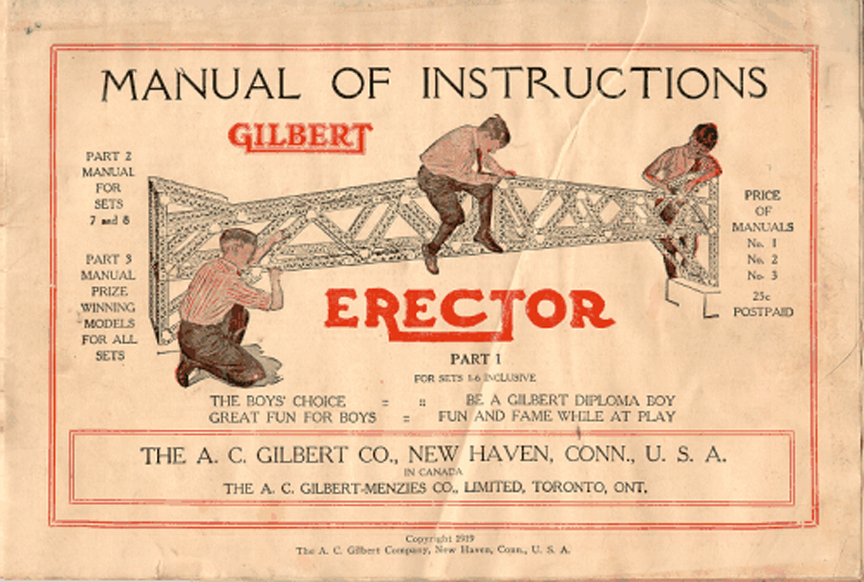
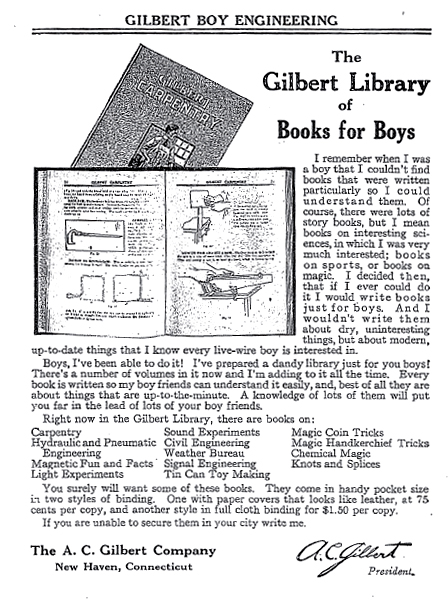
Those with a general interest should just keep scrolling down So what does this have to do with Swing Dancing? (Those of you who came here from a search engine should know that this is primarily a dance website...) The answer is simple: "This is a toy that shaped generations of men, particularly those of the Swing Generation." And "Why," you mak ask, "Did this thing have such an influence?" Look at this: ![]() The Boy's Dream Home, Hearth, Parental Approval This is one of the very first ads for the Erector Set. Please note that the young boy, before the blazing hearth, is building an ENORMOUS bridge in the middle of his parents' living room. Little brother helps out, Mom and Sis admire him and Dad is enraptured by the work. Anything that would promise this level of familial approval had to be a hot seller. And this was it - no father ever (EVER!) got down on his kids for building things with an Erector Set. Construction work, either as a laborer, engineer or architect, was a big ticket item for all classes. Plus, there was absolutely nothing in the Erector set that could be used for obvious antisocial purposes. (See chemistry sets, below) These things would keep children busy for hours as tiny hands fumbled with the bolts and nuts. The only downside was that you really DID have to have some engineering skills to make some of the bigger models, particularly those that required figuring out complicated gearing ratios for the motor. The latter part offered a role for Older Brother or Dad, promoting family harmony. My Dad was never too busy to help with an Erector project, although he avoided my trains and model airplanes like the plague. Let's fast forward to 1957, when I was 13 and very vulnerable to the Erector pitch. This was also the Year of Sputnik when (for a very short moment) it was "cool" to have good grades and to be interested in science. For a month or two, my Dad even stopped referring to me as his "mad scientist" son to the guys at the corner bar. So, here's an ad from Boys Life, every 13-year-old's journal of reference: ![]() The Reds are Bad! Science is Good America's fascination with scientsts lasted just until John Glenn went into orbit... As you can see, all of these All-American boys are having a wonderful time playing with their varied A.C. Gilbert toys. I had most of them, the Microscope kit, the Chemistry set, but not American Flyer trains (We were a Lionel household...) More on these other toys later. Note that the "Walking Giant" is manifesting himself in the upper right hand corner. In order to build Mr. Giant, you had to have the "Number 12 1/2" set. (More about those 1/2 things below). This cost $70 dollars when $1 an hour was a good wage; the mortgage for most people was $70/month. As near as I can figure it, this thing would cost about $2,400 today. Needless to say, the "Number 12 1/2" set remained out of my grasp for a LONG time. ![]() Mr. Giant is more "show" than "go" This graphic really touches on the 12-year old boy's mind A.C. Gilbert was a Princeton scholar, won a gold medal the Olympics in the pole vault, and was a phenomenal businessman. It could be said that he truly "knew boys." Everything that he did or made appealed to the curiosity and fantasies of boys aged 6-16. He made a fortune. When the government tried to prevent him from making Erector Sets during World War One (October of 1917), he went to Washington and made the case that boys with Erector experience made better soldiers. For this reason, he is known as The Man Who Saved Christmas. There was a made-for-TV movie with that name, but Jason Alexander (the Seinfeld's sidekick) was cast as Gilbert. ![]() (l.) A.C. Gilbert in Princeton Athletic Regalia (r.)Jason Alexander Do these guys even remotely resemble each other??? There is a five page article in the November 18, 1946 issue of LIFE Magazine entitled "Alfred Carlton Gilbert, Toy King." I have obtained this issue and scanned it for you. ![]() Headline from the 11-18-1946 LIFE Magazine Article Read the 1946 LIFE Magazine Article The Erector Sets were always popular toys that kept boys interested. They were a radical departure from the run-of-the-mill single purpose toys that had generally been offered to children. I'd like to take a minute to show these "other" toys so that you can contrast them with the Erector Set. It was customary for the Science and Mechanics magazines to publish an article on "New Toys" in their December issue. I have managed to find three of these: 1931, 1946, and 1952. Take a look at them and decide for yourself whether (or not) the Gilbert construction and science sets were really a "cut above."
![]() The 1931 Toy Preview From the "January" 1931 Issue of Modern Mechanics Modern Mechanix Issues were dated by the time they would be removed from the newsstand That is, the January 1931 issue would be on sale during December 1930 up to January 1 1931
![]() The 1946 Toy Preview - First New Toys after WWI Restrictions Were Lifted Gilbert Chemistry Sets and American Flyer Trains Got a Special Mention From the December 1946 Issue of Popular Science Popular Science Issues were dated by the time they were offered on the newsstand That is, the January 1946 issue would be on sale during December 1946 and would be removed on January 1 1947
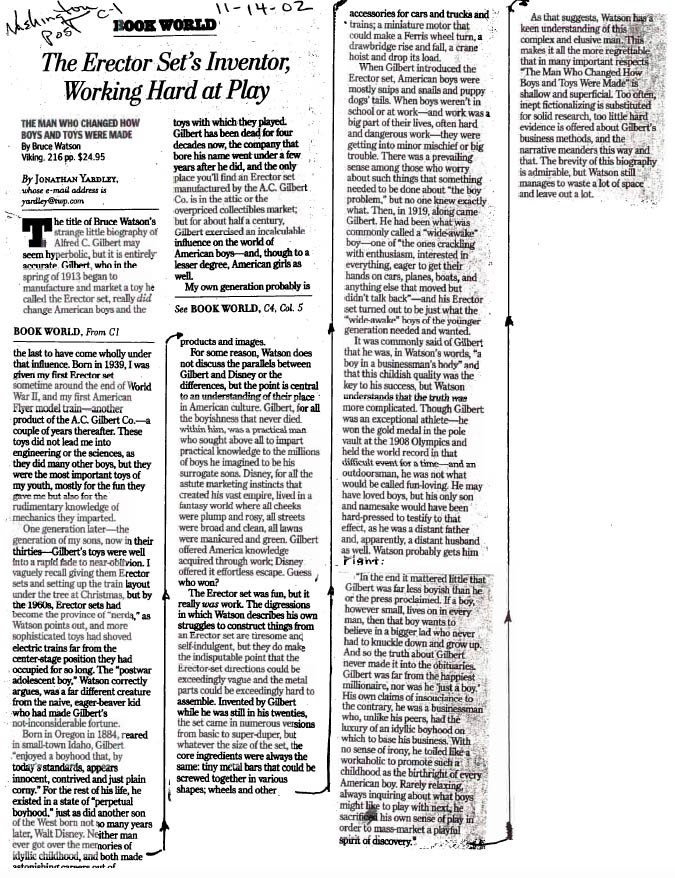
![]() The 1952 Toy Preview From the December 1952 Issue of Science and Mechanics Science and Mechanics Issues were dated by the time they were offered on the newsstand That is, the December 1952 issue would be on sale during December 1930 and would be removed on January 1 1953 Click on any photo to Enlarge It Read the 1931 article Read the 1946 article Read the 1952 article I'm not going to say much more about Erector history because there are a large number of very well-written and informative websites out there. The best is the A.C. Gilbert Heritage Society that covers the full breadth of products made by the Gilbert company. A good site that specializes in construction sets is Girders and Gears. Each of these sites has a "links" page that will direct you to more megabyytes on Erector Sets than you could consume in a lifetime. These guys are the experts. If anything that I say here contradicts them, they are right. Thanks to the Reverend Arnold Taylor, I have come into possession of a marvelous book: Viking, New York (2002), ISBN 0-670-03134-8. Read the review of Bruce Watson's Book Sadly, the Erector Sets of yore could not be sold to children today -- the parts are painted with lead-based paint and the vast array of "small parts" might be a choking hazard. Worse yet, these toys foster individuality -- the Boy had to read the blueprints and figure it out for himself. There were no androgynous committees of well-socialized tykes to put these things together. If you had to ask for help, you were a schmuck, a dolt, a doofus, or a weenie and you probably tried to get out of gym using allergies for an excuse. Today the Nanny State (Lawyers, Bureaucrats, the Public Schools, and Concerned Moms) seems like it is organized to prevent Boys from being self-reliant. On July 5, the Washington Post ran a letter from a Concerned Mom who objected to the printing of a picture of a firearm. She didn't want her "two year old son" to be unduly influenced. [ASIDE: Why do these women always have three names that sound like a trunk falling down a flight of stairs, like Rebecca Dunklesploot Dinkledong?] I'd like to take a minute to take a look at what can happen when the Nanny State keeps Boys from being Boys. Most of the good things that we have come from Science and Industry. Many scholars have attributed the Scientific and Industrial Revolutions in the West to three things: printing, the compass, and gunpowder. Historians now know that all three were invented in China. Unlike Europe, China did not take off onto a path leading from the scientific to the Industrial, leading to the question: Why were these inventions were so revolutionary in Western Europe and, apparently, so unrevolutionary in China? Some have suggested that an insidious team-oriented Civil Service kept China from using the fruits of her inventiveness since commerce was considered less exalted than elite positions in the stratified government.(Others dispute this.) Durng this period of intense scientific progress, landscape art and portrait paintings were brought to new levels of maturity and complexity. Social elites gathered to view art, share their own, and make trades of precious artworks.(Doesn't this sound like today's earth-friendly crowd of Lawyers, Bureaucrats and Concerned Moms?) I note that it is only now that the Chinese nation is waking up and allowing her Boys to make all the things that are lumped under the heading "Heavy Industry." At the same time, the cultural elites are forcing American Boys into a passive, group oriented mold. How many Concerned Moms would smack their Boy if he picked up a hammer instead of a law book? The Boy who yearns to make things is drugged as "hyperactive" until he learns to sit with his hands folded and listen. It is no wonder that the USA is losing its pre-eminence -- all the big factories, dams, bridges, and buildings are going up somewhere else while we preserve the Snail Darter. This weekend, the Post thought that it was important to profile a woman who was a butterfly farmer. Wouldn't it be nice if the media profiled a guy who started a steel mill and provided 5,000 jobs? My effort here will be worthwhile if they inspire just one Boy to say "I don't care what the group says, I know that I can do it!" Maybe if enough American Boys read this and have the experience of making something permanent and tangible, they will go on to lead the USA back to actually producing something. Once again, your options are:
The names of the Gilbert Erector sets always included the figure "1/2." At various times, sets ranged from 1 1/2 to 12 1/2. ![]() Sets always were numbered in half sizez This is the "6 1/2" The "6 1/2" set, pictured above had the largest number of sales and indeed, it is an ideal starter set for an kid about in the 6th grade. It includes an electric motor and enough gears and pulleys to keep a 12 year old busy for along time. Each set roughly corresponded to a grade in school. Kids always want to appear older than they are, and often give their age using the fraction "1/2" (As in, "I am almost old enough to drive -- I'm 15 1/2"). So, my guess is that the set numbers were assigned to give parents an idea of what is age appropriate. They also made kids want the next model. Over the years, the "5 1/2" and "9 1/2" models went into- and out of- production. The "9 1/2" was only made in the 1940s and comes in a blue metal case. For some reason, Gilbert never made an "11 1/2" set. Sets "1 1/2" through "3 1/2" came in cardboard boxes. Set "4 1/2" was offered in both cardboard and metal. For some other reason, set "5 1/2" only came in cardboard. All the rest came in red metal cases (During the 1930s, there were also green cases). To summarize: I only collect models in metal cases, which is why I only have 4 1/2 through 12 1/2 with the exception of 5 1/2 (only sold in cardboard box) and 11 1/2 (never made). There are a variety of specialized sets from the 1920s that made a truck, a zeppelin, and a locomotive. These are really expensive! My collection is more-or-less run of the mill. Meet Bill Bean, who has every erector set ever made. Needless to say, he was the technical advisor for "The Man Who Saved Christmas." ![]() All the Metal Box Sets 1946-1957 No 5 1/2 or 11 1/2. These are my sets, all restored by me from parts and pieces that I have acquired at yard sales, flea markets, etc. I have supplemented some with parts that I bought through the Internet (competent suppliers listed below). This work has gone on for a period of 15 years. In the 1980s, the boxes were easy to find and parts were cheap. Low numbered sets were sold in great quantity while high numbered sets were sold in much lower amounts. Hence, parts for the 10 1/2 and 12 1/2 are difficult to find. The most difficult item is the DC powered "P-55" motor that was used for the Walking Giant. This is really an American Flyer motor rigged out to work with an Erector Set Gearbox. I will confess that I had to resort to an internet auction to find my "P-55" ![]() The Elusive P-55 DC Motor You got a choice AC, DC or Spring-wound.
The 4 1/2 set was the smallest set to come in a metal box. For some reason, the metal box was very desirable, probably because it let boys emulate their Dads or at least those Dads that carried a toolbox. This set offered the rudiments of construction, including powered motion. At this level, kids were only trusted with the spring-wound motor. That's probably a good idea because I still make mistakes and come close to electrocuting myself. (Moms: the spiritual development of the Boy is predicated on taking risks.) ![]() The "Christmas Day" view of the Number 4 1/2 set Magic, Mystery and Possibility Above, you will see what the 4 1/2 set looked like when the Boy first opened it, most likely on Christmas Day. The Gilbert folks were very careful to manage tis experience, giving the Boy a glimpse of gears, motors, girders, pulleys and the like, all arrange with perfect symmetry. As you read on, the "Christmas day" look of each set is very important, setting the tone for the set. ![]() Complete view of the Number 4 1/2 set Layers of Imagination
![]() Trip hammers Just in case you're not Chinese... That's not quite true -- the trip-hammer would be a complete puzzle to an American boy, but not to a Chinese boy. Did you know that we used to make something besides lawsuits and hamburgers in the USA? The complete set had parts arranged in layers. The bottom layer was a cardboard tray and parts were held on by "Tee Pins" or "Prong Fasteners". Miscellaneous parts (and duplicates) were wrapped in brown paper and hidden under the cardboard tray. A sheet of waffle-weave cardboard protected each layer. The little "Erector" flag is an important component of each set -- it was used to "finish" many projects. Also included (but not shown) is a hank of blue string that was used for projects requiring pulleys. There was also the "How to Make 'Em" book that provided the sometimes cryptic instructions for the models. Note the look of wonder and amazement on the little boy's face as he contemplates the possibility of making the Giant Powerplant. Later, he will be somewhat disappointed to learn that this particular Giant model can only be made with the 10 1/2 set.... All Erector models were "Giant" in the sense that the smallest cup of coffee at Starbucks is "Grande". ![]() The "How to Make 'Em" Book" This was developed at the Gilbert Hall of Science, not some grubby factory! I have eliminated this insruction book from my photos because it usually covers the top layer.
![]() The "Christmas Day" view of the Number 6 1/2 set Even More Magic, Mystery and Possibility The 6 1/2 set began the inclusion of an electric motor and was known as the "All Electric" set in the sense that you didn't get the spring-wound motor. The label in the inside of the box-top gave the boy a picture of the most complicated project that could be built with the set. In this case, it is an amusement park airplane ride. This was no mean feat because the boy had to change the direction of motion from vertical to horizontal using beveled gears. This set begins to challenge the owner in the same way as the real world of engineering. ![]() Top Layer of the Number 6 1/2 set ![]() Bottom Layer of the Number 6 1/2 set The screwdriver set you apart Apart from the electric motor, the other feature of interest was the yellow-plastic handled screwdriver (Part "NZ"), shown in the bottom layer. The models befor 6 1/2 used a cheap screwriver fashioned out of metal rod. The 6 1/2 screwdriver was professional, just like many real engineers carried. This became a talisman for the boy who wanted to show his peers that he had moved up to the "All-Electric Set." People still value these so much that they have even re-cast the handles to restore them with full accuracy. The 7 1/2 set is the first to have "rails" that divide the space into three segments. The LEFT holds the A-47 electric motor and the "MX" House. The MIDDLE holds a top and bottom tray and the RIGHT holds the Boiler (Erector Part "T"), which is the key to all the "big league" sets. This latter part does not actually boil anything -- rather, it is a rounded piece of steel that can be shaped into a cylinder. It can be made to look like almost any component of a complicated machine. ![]() Introducing the Boiler in the Number 7 1/2 set The signature piece of the 7 1/2 set is the Walking Beam Engine a very early steam engine from the time of James Watt. Steam is not involved -- the electric motor supplies all the power -- in a sense the boy had to spend a lot of time and effort using an advanced technology (electricty) to simulate the actions of an obsolete technology (steam.) ![]() The Walking Beam Engine Model Almost Like James Watt's Engine Why do it? Even as late as 1950, it was possible to see these old Walking Beam monsters running pumps. With only a brief bike ride into the country, you could watch them operating in the legion of small oil wells that surrounded the Pittsburgh area (Pittsburgh was the OPEC of the 1890s, beginning with the first oil well in Titusville, Pa.)
![]() Top(l.) and Bottom (r.) Layers of the Number 7 1/2 set Two Parts Cans The top and bottom layers of the 7 1/2 set are marked by the careful attention to symmetry in the arrangement of parts. All of this is calculated to get a resounding "Gee Whiz" from the lucky boy who received this set on Christmas Day. I really never heard of anyone getting an Erector Set for his birthday. It was always on Christmas. The 7 1/2 set had a slight flaw -- the compartment on the right is not quite big enough for the boiler. The part had to be coiled up tightly and crammed into the slot. After that, it had to be assembled: ![]() Assembling the Boiler The Nut Holder (Part "MW") Was a Very Important Tool Before leaving the 7 1/2 set, we should take a minute to look at part "MX". This is the little "house" or "shack" or "control cab" that came with every Erector set. This is the most memorable part because it was already assembled and gave a human touch to the project. The Boy could imagine himself in that shack, operating the machinery or getting out of the cold and rain for a cup of "java." The MX is common to all Erectors ets and represents a great democratizing trend. No matter how poor you were, you always could imagine a roof over your head. People hung on to these things. I have never seen a set, no matter how poor condition, without "MX". Some sets may have two, three or four of them as people moved up the chain and pooled their sets. The 8 1/2 Set is also known as "The Ferris Wheel Set" -- it contained enough parts to construct a very detailed model of this amusement park ride. ![]() The "Christmas Day" view of the Number 8 1/2 set The Ferris Wheel For some reason, the folks at the Gilbert hall of Science thought that amusement park rides would be of interest to Boys. We have already seen the "Airplane Ride" as the signature of the 6 1/2 set, and the trend continues with the 8 1/2 set. The complete instructions for the Ferris Wheel ran to six pages. ![]() Instructions for the Ferris Wheel Note that the model includes Part "MX" -- in this case, the ticket booth ![]() Mt. Gilbert Patented the Erector Ferris Wheel Design (Patent 1,804,926) Click on the Patent Drawing to Enlarge It Our Patent Page will tell you how to get patent drawings for free The 8 1/2 set was considerably bigger than the 7 1/2 set and had quite a few more parts. Of note is Part "MJ", the lifting electromagnet seen at the bottom right in the picture above. This could be connected to a couple of "D" cells and it was possible to construct a crane that would lift any iron or steel parts (when the current was on). Shutting the current off would drop the parts, so you could spend hours playing "junkyard" lifting model cars into a dump truck. The "Stiff Leg Derrick" was powered by the mighty A-47 motor and operated with pulleys, gears, etc. just like its real world counterpart. In this case, "MX" plays the role of Control Cab. ![]() Stiff Leg Derrick with Lifting Magnet This is really a nifty piece of engineering ![]() Mt. Gilbert Patented the Lifting Derrick Design (Patent 1,996,722) Click on the Patent Drawing to Enlarge It Our Patent Page will tell you how to get patent drawings for free ![]() Top Layer of the 8 1/2 set Bottom Layer of the 8 1/2 set The two layers show the Gilbert company's penchant for attractive, symmetric display.
The 9 1/2 set was the "top of the line" for quite some time. This is a heavy set, about 35 pounds that has a lot of specialized parts. ![]() The Distictive Blue Box Only During the late 1940s The 9 1/2 set was only made in a blue box during the 1940s. There are comparatively few differences between the 9 1/2 and 10 1/2 -- and when the latter was issued, the former was discontinued. Although the graphic on the inside of the top lid is much like the 8 1/2 set, an add-on sticker gives a clue to the signature model for this class -- the Parachute Jump. ![]() "Builds the Parachute Jump" As we have noted, the folks at Gilbert thought that amusement park rides were of great interest to Boys, and the most exotic "ride" of the 1940s was the famous Prachute Jump at Coney Island where patrons were hauled up 262 feet in the air and dropped on parachutes! Here is a picture of the actual "ride" and an ad for Erector sets featuring the Parachute Jump.
![]() Click here for a complete discussion of the Parachute Jump. The Parachute Jump required actual parachutes (Part "NU"). These were made of silk and had a little paper "parajumper" at the end. They are almost impossible to find in orginal condition, so I have included a link to a site that tells you how to make them from scratch (see below in the "restoration" section) Advanced Erector Parts Part "NU" is the Parajumper Of some note are two additional parts categories: "CS" is a circle segment, comprising 1/8 of an arc; these may be bolted together to form a ring about a foot in diameter that is the foundation for many models (see Carousel, below). In addition, Part "CA" is a signal arm", part of a plan by the Gilbert company to integrate Erector models with American Flyer trains. In fact, the Back Cover of the How to Make 'Em Book shows an integrated layout with Erector Amusement Park models and American Flyer Trains. As usual, the scale is exaggerated. ![]() Trains and Amusement Park Rides A Clever Marketing Trick Here are the views of the layers of the 9 1/2 set ![]() ![]() You got TWO Boilers Once again, the parts are laid out in a very tempting fashion, maximizing the impact of Color and Symmetry. Gilbert certainly knew how to inspire Boys! The 10 1/2 set is somewhat anticlimactic -- it is only marginally different from the 9 1/2 ![]() The "Christmas Day" view of the Number 10 1/2 set The Carousel has been added The principal difference between the 10 1/2 and the 9 1/2 is the Carousel -- the former has a few more girders and the distinctive Horses (Erector Part "OF") These horses were originally made out of paper and have long since vanished. I had to make my own, as outlined below in the Restoration section. ![]() Closeup of the bottom tray This isnt intuitively obvious, except when it is pointed out... In order to help you put your 10 1/2 set together, I can share something that took me a lot of puzzling. The top tray is supported by two 18 1/2" right angle girders (Part "MB") that fit through the "L" shaped slots in the box ribs (as shown in the photo.) In addition to supporting the tray, they also help hold in the contents of the right and left chambers (Boilers, Motor, "MX" Shack, etc.) ![]() The "Box" for the bottom layer This is made out of illustration board The bottom layer is a cardboard box that has cutouts for the various items, Parts Cand, "CS" Boxes and the like. Girders, gears, baseplates and the like are artfully arranged on the box and held on by split end brass fasteners that pass through strategically placed holes. Original boxes are almost impossible to find, and I bought this one from a supplier. In the "restoration section" you will find templates for making your own boxes, although it does take a lot of time and patience. ![]() The Completed Bottom Layer This shows the "CS" boxes and Parts Cans in place Once again, I am very impressed with the Gilbert Company's use of color and symmetry to create an attractive display. Of course, once the Boy began to use the set, it degenerated into a massive tumble of parts. Putting one of these sets back into original condition is like reversing entropy...it takes a lot more effort to get it organized than to take it apart. ![]() The Total Set The Horses and Parachute Jumpers give it flair This is the complete 10 1/2 set -- it really has a very smart appearance. ![]() The Inside Lid of the 1949 12 1/2 Set It became a ROBOT in 1950 The 12 1/2 set has everything that all the smaller sets have (of course in larger quantities...) with the addition of some unique items like the remote-control P-55 DC motor and its electrical transformer. In 1949, the lid referred to the "Walking Giant" -- however in all subsequent years, this fellow became the "Walking Robot." ![]() Bottom Layer of the 12 1/2 set Layers of Imagination This set has a large number of trays -- there is a bottom box that holds the "MX" shack, the wind-up motor, the magnet and the two boxes for "CS" segments as well as four parts cans. In addition to this, there are six compartments at the front that hold the two boilers, the A-47 AC motor, the treads and remote control, the DC P-55 motor and the Transformer. There are a considerable number of parts underneath the bottom box as well. ![]() Top Layer of the 12 1/2 set These stand out The Top Layer is composed of two trays. The back tray holds wheels, gears and large girders and the Horses, and it rests on rails. The Front Tray is made up of "MN" baseplates bolted to the 18" "MB" Girders, and it rests on the compartment walls. All of the parts are displayed with the impression of limitless possibility. ![]() Front Page of the Instructoins for the Walking Giant Four Pages of Detailed Drawings This is the beginning of the part of the instructions that explain the construction of the Walking Giant. They use every trick in the book!. ![]() Variations on the Walking Giant Eight Possibilities There are a wide variety of configurations that have been dreamed up for the "Walking Giant". Here is an article that will explain them all. The Giant/Robot even managed to make the cover of the December, 1948 issue of Popular Science: ![]() Walking Giant, Cover Guy From the December 1948 Issue of Popular Science Click on the Photo to Enlarge It Nex, we'll show you the kind of sets produced by Gilbert's competitors. ![]() Case for the Constructioneer #12 set Competition for the Erector 12 1/2 Set Over the years, a number of companies produced construction sets that competed with the Gilbert Erector Set. One of these was the Urbana Manufacturing Company (of Urbana, Ohio.) Harkening back to A.C. Gilbert's World war I experiences with steel priorities, it seems that the just after World war Two,Urbana company had accumulated a fairly large surplus of steel -- most likely the result of bureaucratic bungling of some sort as was common during the period. In short, Urbana had steel while Gilbert did not, so they plunged headlong into the postwar boom in children's toys by offering their own toy whose name fused the words "Construction" and "Engineer." Both words, as we have observed above, were music to the ears of parents. The Constructioneer sets were first sold in 1946 and lasted only until 1952 when Urbana was put out of business following a Patent infringement case brought by Gilbert. As you will see below, there is little mystery in why Gilbert brought the suit. Constructioneer sets came in red metal cases and were originally numbered 4, 6 and 8 while [not-so strangely] the most popular Gilbert sets were 4 1/2, 6 1/2 and 8 1/2. The Number 12 set featured here was offered only in 1950 and is a response to the hullabaloo created by the Gilbert 12 1/2 set. The Constructioneer sets featured amusement park rides, and the #12 set featured a carousel with horses. The major difference between the sets was that the Constructioneer's "Wasp" engine only worked with pulleys while the Erector's A-47 motor was famous for all sorts of gear/pulley combbinations.
![]() "Christmas Day view of the Constructioneer #12 set Lots of Color The Constructioneer set had a lot of color. The #12 set had four major components: (1) the Case; (2) the Blue Tray; (3) the Yellow Tray; and (4) the Platter. The photo above shows what the set would have looked like when the Boy first opened it on Christmas Day. As you can see, liberal use was made of Red, Yellow and Blue. You'll also note that the parts are much more representational -- the Ferris Wheel seats (middle left) actually look like their amusement park counterparts while the Erector set required that you build these seats out of more general parts. The drawback is that the seats take up a lot of room and they can ONLY be used for the Ferris Wheel. ![]() Empty Case for the Constructioneer # 12 "Parts" were in a box, not a can This is the empty case. There is about 1.5" of clearnce under the Blue Tray and this was used for the storage of miscellaneous parts that could not be attractively displayed on the top trays. The bolts, nuts, and collars were kept in a rectangular box, shown in the center of the bottom part of the case. The "parts Box" had a distinctive design that I was able to copy, although the origial box was to dilapidated to actually hold anything. In the downloads section, you'll find a ".jpg" that can be used to cover a replacement box of your own making, should you desire to restore one of these sets. ![]() Minor Parts for the Constructioneer #12 Set Tools, Axles, Cranks, etc. Here are some of the "minor Parts" that were wrapped in brown paper and stored beneath the Blue Tray. ![]() The Yellow Tray Girders, Wheels, pulleys This is the Yellow Tray that held most of the "flat" parts like girders, wheels, pulleys, etc. The Platter (with the horses) mounts on top of the Yellow Tray. ![]() The Blue Tray Motor, Seats, Plates, Propellors and the Cement Mixer This photo shows the Blue Tray fitted out with all its various parts. The "Wasp" motor (bottom center) fits through the tray and its cord is stored below. The amusement park seats and propellors add a festive touch. In the Top center, is a Cement Mixer part that was very representational. There is no Erector part that corresponds to this. ![]() Yellow Tray Mounted in the Case Loose Parts Were Stored Under the Blue Tray The yellow tray was attached to the case by two metal tabs. This photo shows the Yellow Tray plus Platter fitted to the case as well as the miscellaneous parts wrapped in paper and stored in the case bottom ![]() Blue Tray Mounted in the Case This photo shows the final assembly of the Set. On balance, I found this set to be of poorer quality than the Erector and it did not appeal to the imagination. I have it as a curiosity, but I do not display it with my Erector sets. This is much rarer than any Gilbert product, but it is not exciting. I have scanned in the Constructioneer manual and I will be very glad to share it with you. Unfortunately, it requires about 7 MB. Since I pay by the byte, I haven't included it in the downloads section. BUT if you contact me, I will be very glad to e-mail you a copy. You should have a fast connection to do this... These are lessons that I learned in restoring things. I have benefitted by the wealth of information that is on the Internet and I will salt this discussion liberally with references to authoritative sources. Any expertise that I have to offer is because I am standing on the shoulders of giants.
Painting: During the Christmas season of 2007, there was a major brouhaha about lead-based paint in toys from China. If you are a Concerned Mom, you'll probably want to keep your precious little brats away from historic Erector sets, because the paint is 100% lead-based. In fact, the yellow parts are covered with pure lead chromate. [Of course, Concerned Moms would't want their non-female children to play with anything as plebian as a construction set. The only 21st Century toy acceptable for the Perfect and Special Child would be "The Little Envrionmental Lawyer" kit.) Back in the evil old 1940s, the Boy knew that you didn't stick Erector Set parts in your mouth, and that any kid dumb enough to do that got what he deserved. Thanks to Concerned Moms and the Product Safety Bar, a vast amount of money and energy is expended on protecting dolts from themselves. Politics aside, painting is pretty straightforward because the Gilbert company kept to primary colors. Most of the boxes are in pretty bad shape -- the paint scratches very easily and Boys are not known for being gentle. Sad to say, when the Boy discovered Girls and Cars, the poor Erector set got stuck in the basement along with Puff the Magic Dragon. Thus, you'll probably have to repaint the box. You'll have to remove the paint down to bare metal. ![]() Get it down to bare metal! Clean thoroughly with Naphtha After careful sanding, you must clean the box thoroughly with a degreasing solvent that leaves no residue. Naphtha is best for this purpose, but please remember that it is quite flammable. After that, spray with a good quality metal primer and let it dry throroughly. After that, you can apply the color. By the way, the same advice holds for painting parts: sand, clean with naphtha and prime. Here are widely available [and legal...] paints that match Erector colors:
![]() The "Kneeling Boy" Label VERY easy to replace The metal box cases should have a "Kneeling Boy" label on the top. Years of abuse have most likely scratched and abraided this label beyond recognition. Fear not, because you can download a VERY high resolution ".jpg" of the label and then print it out on Avery "Large Label" (#8165) stock. This will put a quality copy of the image on a self-adhesive back, more-or-less like the original. Of course, if your box has a pristine label, then you should mask around it before you paint. More Help from the experts
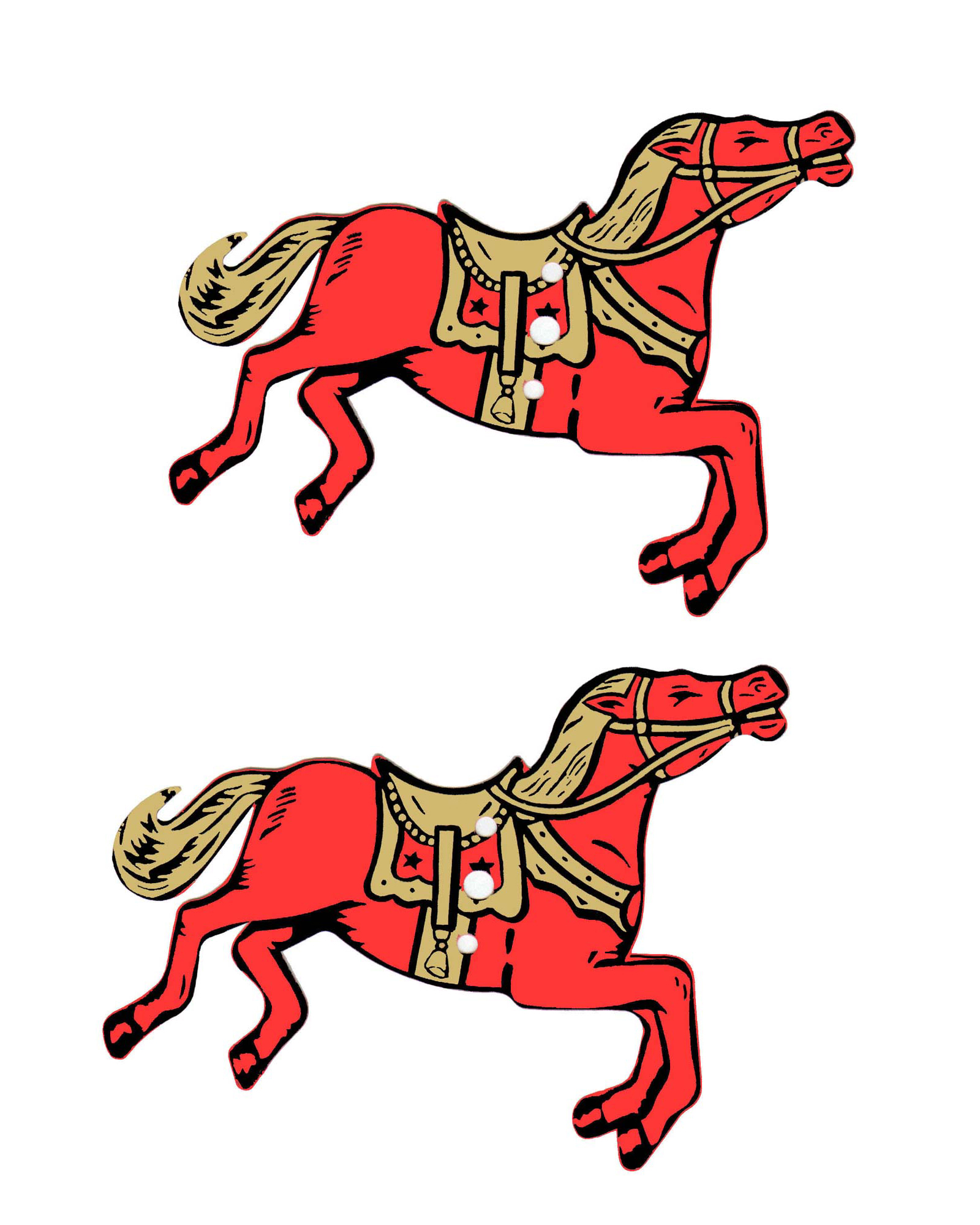
With a little ingeneuity, you can repair or reproduce ANYTHING in an Erector set! Parts Cans The distinctive Art Deco "Parts Can" is a charming part of the Erector Sets of the late 1940s through the 1950s: ![]() Parts Can Label Two inches in Diameter The original parts cans were two inches in diameter and about 1 1/2 inches high. The top was thin pressed metal and the can itself was made from a cardboard tube with a metal press-fit body. Because they were mostly paper, most of them are long-gone. If you have one can, you can try to duplicate it by using mailing tubes and sheet metal along with a LOT of time and patience. If you want to have a place-holder until you can obtain a genuine parts can from a supplier or auction, replicas may be fabricated easily. Go to a plumbing supply store and buy a 2" PVC pipe cap -- this is the exact size of a parts can and is indestructible. Next, go to a supermarket and buy a package of toothpicks in a clear plastic tube with a white snap-on cap. (that just happens to be two inches in diameter). Obtain the "jpg" for parts can labels and print them out on GLOSSY PHOTO PAPER. Cut them out and apply to the cap with super-glue or contact cement. I have found that printing these labels on Avery label stock does not give you the color-brilliance of the original parts can. ![]() Making the Substitute Parts Can This is only a place-holder! Other generations of Erector sets use a very different parts can -- the [above] technique only applies to 1940s and 1950s sets. Please don't try to pass these things off as if they were originals! I am writing for the people who want to evoke the feeling of an original Erector set, not for people who try to sell restored sets. Always tell people what's original and what's not! Part "OF" - The Carousel Horses ![]() The Carousel Horse (Part "OF") Originals in paper, later versions in plastic The Carousel Horses were introduced with the 10 1/2 set and were made out of a stiff fiberboard paper. Later, they were made of plastic. These weren't particularly valued by kids and tend to be scarce. Paper horses are very hard to find. So, here are some tips for making carousel horses for yourself. First, go to the download section and obtain the "Two Horse" picture. I have placed the images of two horses on one 8 x 10 image so that you can print them efficiently. Print the picture on premium glossy photo paper using the "maximum DPI" printer option. Printing two to a page will save you money because photo paper is quite costly. Obtain a sheet of 1/8" thick chip-board (color: black) from an artist supply store. Use 3-M Spray-Mount (3M product no. 62-4662-4827-5) to mount the photo-quality prints to the board. The two will become inseparable! ![]() Attach the Photo to the Illustration Board DO NOT use any water-based glue! You may then proceed to cut-out the images. Chipboard is pretty tough, so I used a little DC-powered hobby jigsaw for the rough cut and an artist's knife for the fine work. ![]() Carefully cut the Carousel Horse Figures out Take your time! You can use an emery board to smooth the edges. When you finish, go over the edge with a black felt-tip marker to cover the "white" remaining on the cut edge of the photo paper. ![]() Punch Three Holes in each Carousel Horse figure Use a Leather Punch Use a leather punch (available at Home Depot for about $10) to punch the three holes that are used to mount the part to the carousel. The middle hole is slightly larger than the top and bottom. ![]() Make Six Carousel Horse Figures It takes about an hour for each one... You'll need six of the Carousel Horse figures. It took me about an hour to do each one. If you have more money than time, you might consider buying a set from an internet auction. ![]() The Final Step Pin through the Middle Hole This is what the set of six horses looks like when it is mounted in the top layer of my 10 1/2 set Part "NU" -- the Parajumpers Here is a tutorial on how to make the little parajumpers that are in sets 9 1/2 through 12 1/2. ![]() This is the Parajumper You need four of them... I agree wholeheartedly with the tutorial and would add four small suggestions:
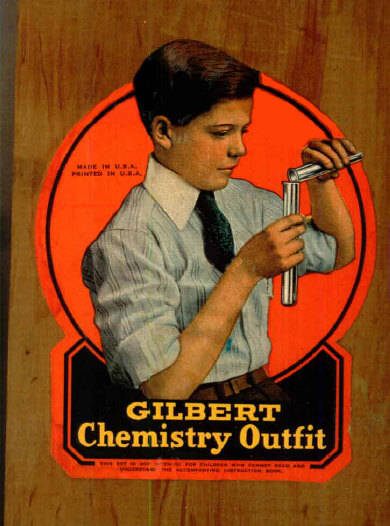
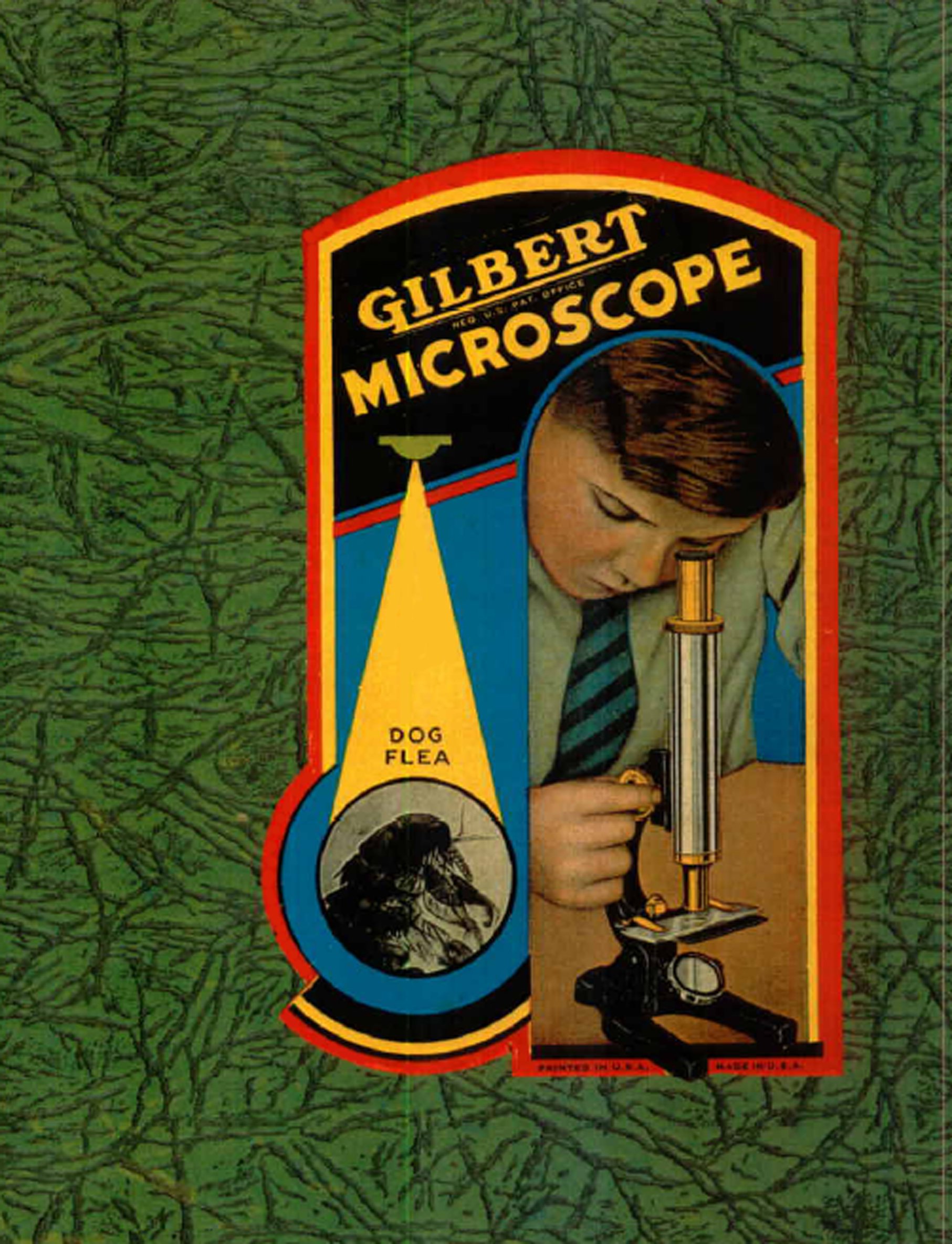
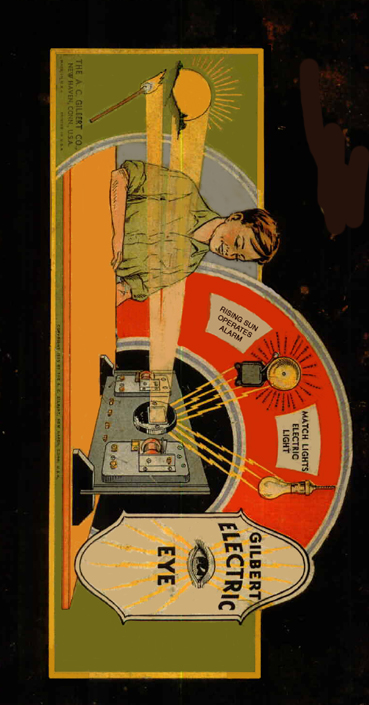
![]() Helpful Suggestions for making Parajumpers otherwise follow the tutorial... You should have smooth sailing -- ask your wife, mother or girlfriend about this "bias" business... A convenient document for printing out the images (front and back) of all four parajumpers at once (saves photo paper...) is provided in the Free Downloads section. Labels for Sets We have been busy with our scanner. You can download box labels for the Erector Set, Chemistry Set, Microscope Set and the astounding "Electric Eye Set". ![]() Box Labels We like the Electric Eye Label... Go to the Free Downloads Section to get them! Cardboard Inserts for Sets I have two kinds of Erector sets -- the more-or-less careful restorations and the stuff that I actually use to make models. The original Erector sets are high on "curb appeal" but they are a disaster for model building because the various parts are not particularly accessible. This also explains why the sets are a real mess when you get them. My "working" set has all the small parts in a tackle box with each type in an individual compartment. Tool boxes are used for the other parts with girders in one and base plates in another. This prevents the "Omigosh where did the P-73 get to..." moment. However, if you want the glory of a restored set, you will have to acquire the cardboard inserts. Here, you have two choices - you can buy them or you can make them
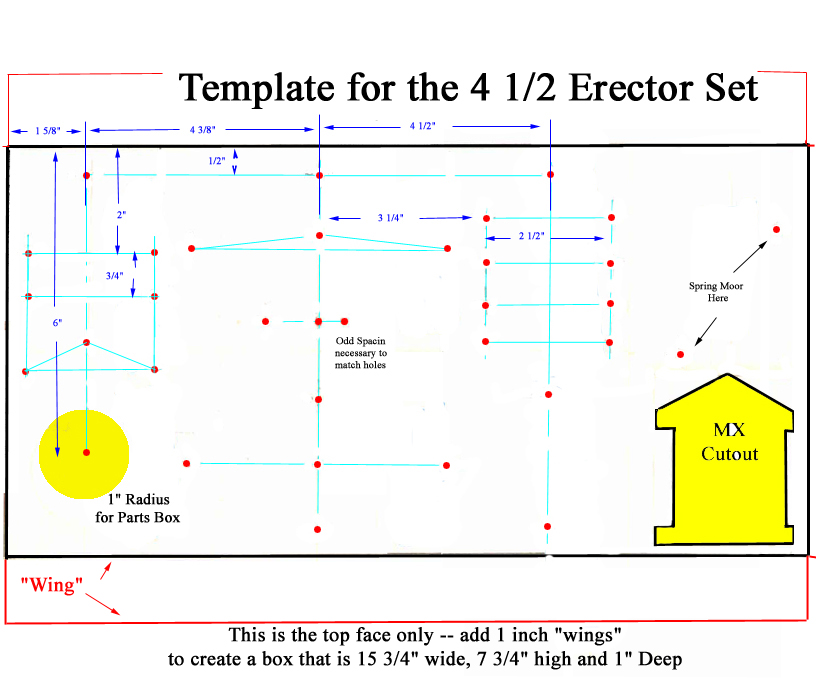
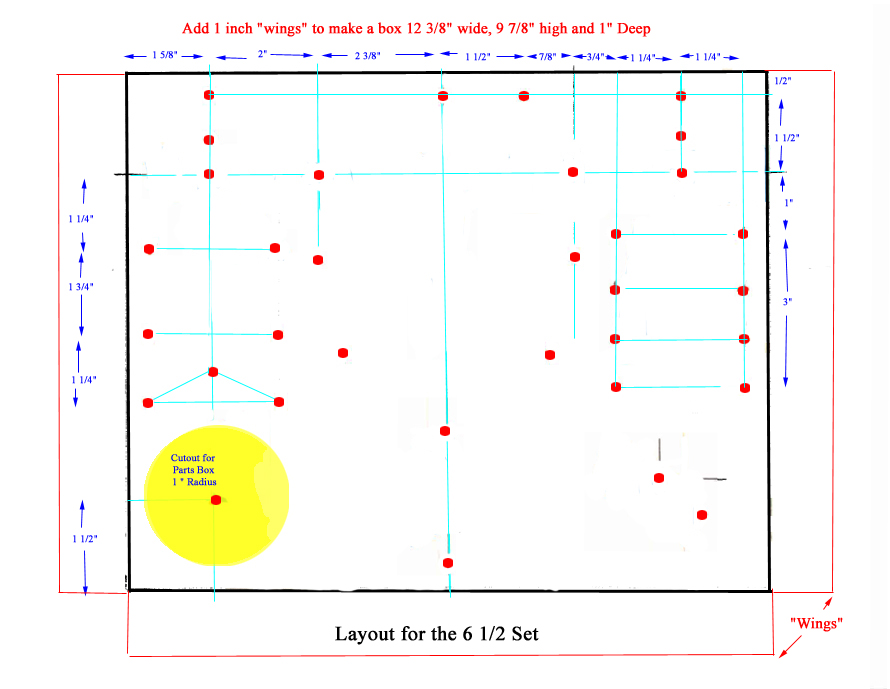
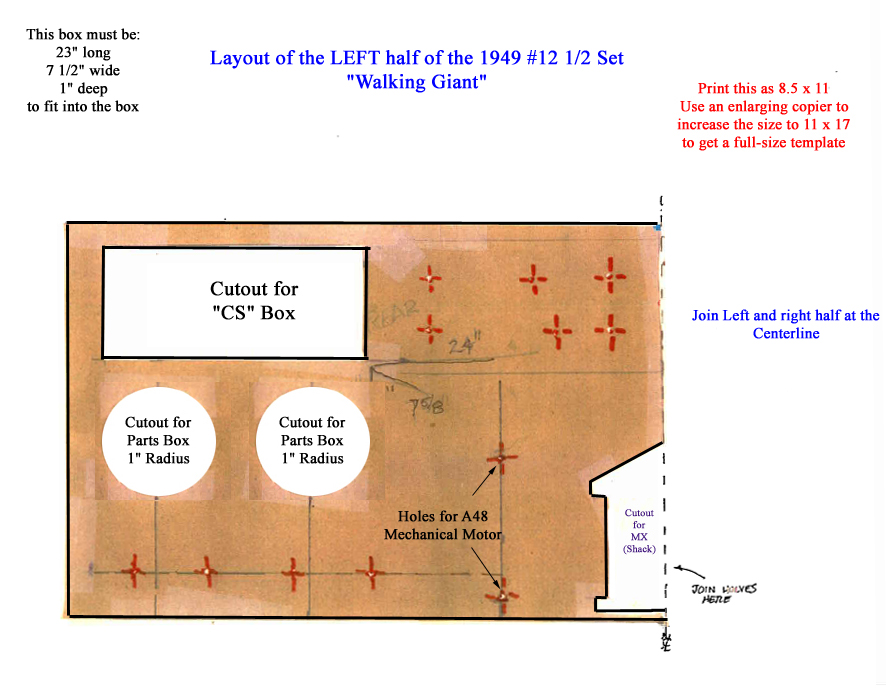
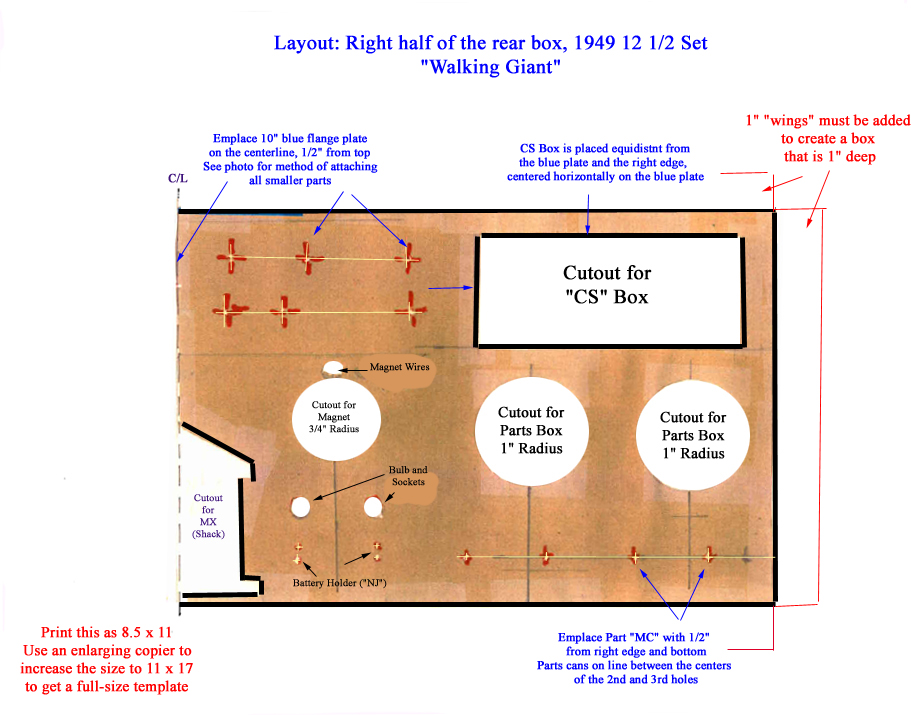
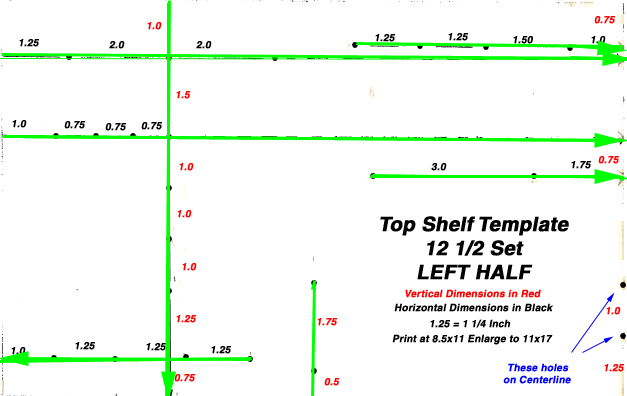
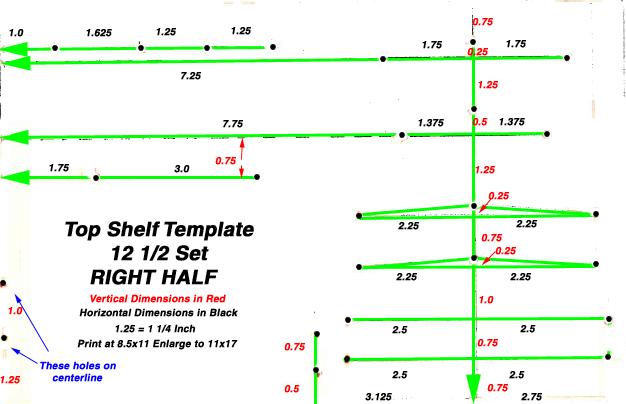
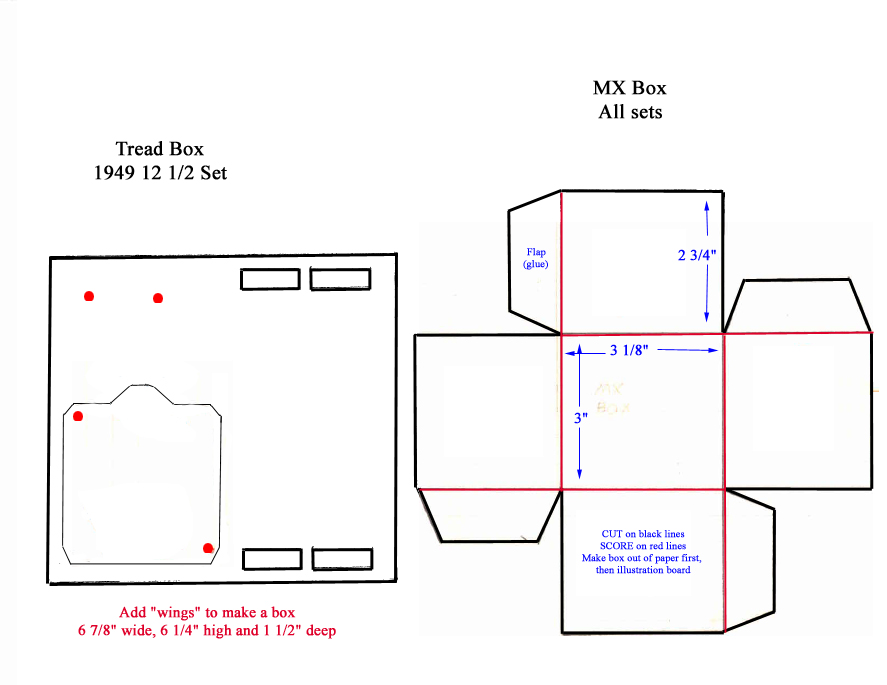
Once again, please do not try to pass EITHER of these off as "originals". Here are small photos of the templates that are available in the Free Downloads Section -- a photo of the layout of parts has been superimposed on them to give you an idea of how things are to be arranged :
![]()
![]() ![]() Templates for Cardboard Inserts Here is a sequence of pictures that illustrates the basic principles of cutting out the various cardboard inserts. ![]() The Magnet Box Folding the wings makes a box ![]() Underside of the Magnet Box Note that "scoring" means "cut halfway through" ![]() Finished magnet Box The bulbs screw into the sockets Here are some more simple inserts -- the "MX" Box and the "CS" box ![]() ![]() The box for Part "MX" -- the House or Control Shack ![]() The Box for parts "CS" - Circle segments All you have to do is take your time. Make a temporary paper pattern just to be sure that you understand how the thing folds and how the parts fit... . ![]() Make a Paper Pattern and try it out before you go to the illustration board Measure twice, cut once For these inserts, I used a heavy illustration board, available from an artists' supply store. NOTE: the templates are downloaded as an 8 x 10 ".jpg." Print them at 8x10 and then take that to an enlarging photocopier and copy at 11x17 -- this will give the full size pattern. Why? Few people have a printer that can handle 11x17 paper. Why is it that Boys can be very constructive with the Erector Set and become utterly destructive with a Chemistry Set? One would think that there is some male gene that wants to either make an explosion or a foul smell (or both...) I will plead guilty to this. On the day I got my Chemistry set, my friends and I became demolition experts. Gunpowder was fairly easy to make and we detonated home-made firecrackers, rockets, Molotov Cocktails, and pipe bombs with a regularity that might remind you of Baghdad today. The strange thing was that you could buy all the stuff you needed for gunpowder at the local drug store. If you got hold of a chemical catalog, you could send away for even more powerful substances. In fact, Experiment #1 in the Chemistry Manual indicates that Gilbert wanted to "get it over" before proceeding to Science: ![]() Experiment No. 1: Explosions Telling the Boy not to make it bigger is like waving a red flag at a bull... HOWEVER - at the time, the Gilbert Chemistry Set got the Good Housekeeping Seal of Approval: ![]() The Good Housekeeping Seal Repair or Replacement Guaranteed In today's Homeland Security Crisis Mentality, I'm not even going to mention the ingredients that we used, only to say that by the 9th grade, we were making three-foot deep craters and clearing out large rooms with stink bombs. Today, this kind of behavior is grounds for arrest and commitment to a nuthouse. Back then, it seemed to be the norm. When I was a freshman at Carnegie Tech, it seemed that all the National Merit Scholars had a homemade bomb story. All of these people grew up to be responsible scientists and engineers. I have scanned the whole Manual for the Chemistry Set and you may read it in the the Free Download Section ![]() The Cover of the Gilbert Chemistry Manual Elementary Set, 1930s If you place "Gilbert Chemistry set" into a search engine, you will find a large number of citations from scientists who got their start with one of these outfits. Here is an ad for some of the more elaborate sets that feature testimonials from promising young scientists: ![]() Testimonials for the Chemistry Set We LOVE the "No. 15 Master Scientist Set"... To be fair to the Boys of 1957, there was never any intent to harm normal American people; our targets were clumps of dirt or the ruins of a building long abandoned on the old Harmony Short Line. Generally, these experiments were justified as practice for what we would when the Reds invaded Pittsburgh. Iraq would seem like a picnic if someone should try to occupy the USA -- even today's over-socialized male children would switch on their "destroy" gene and go to work. The Chemistry set MUST have been good because it was endorsed by SUPERMAN! ![]() SUPERMAN Visits the Gilbert Hall of Science ![]() SUPERMAN Gives a Pass to the Chemistry Set This little 32 page booklet sells for about $500 today.... Given this history, it was with some pleasure that I managed to find an old (c.1920) Gilbert Chemistry set in a wooden box. The box was in good shape and some of the chemicals were still present. However, someone had been using a candle and several test tubes and instruments were encased in wax. ![]() The Exterior, as found ![]() The Box Latch ![]() The Interior, as found ![]() Some of the chemicals and containers were intact ![]() The Melted Wax Mess With some amount of work, I was able to restore as much as was available. and had to "fill-in" places with modern test tubes. I did not want to replicate the chemicals that were in the original set. Rather, I scanned in a label and created the "Boys Ideal Chemistry Set" with Plutonium, d-Lysergic Acid, Trinitrotolulene,Tetrahydrocannabinol, and other unusual substances. You can find these "augmented" labels in the downloads section. There is also a blank label so that you can restore your set to full authenticity. ![]() The Boys' Ideal Chemistry Set Concerned Moms may faint.... However, my "ideal" set is not that Far-Fetched -- the Gilbert Company actually sold a kit that included Uranium and Radioactive materials: ![]() The Gilbert U-238 Atomic Energy Lab Just the thing for kids after a breakfast of high sugar cereal The "Gilbert U-238 Atomic Energy Lab" was introduced by A.C. Gilbert in the spring of 1950 and sold for $42.50. Its components included:
![]() Dagwood Splits the Atom Mandrake the Magician is the Expert Gen. Groves of the Manhattan Project was just the Technical Advisor Read the Whole Thing If You Want! None of this is the least bit harmful, but Concerned Moms and Product Safety Lawyers would have a field day if this set were to be offered today! I can assure you that (in 1957) if my friends and I had access to fissionable materials (and a heavy duty machine shop) there is absolutely no doubt that we would have built a thermonuclear device. There is some doubt as to whether we would have tested it... The Microscope SetI never did anything particularly destructive with the microscope set, although I looked at samples of almost everything. Insects were particularly attractive -- the Gilbert company gave you bees, flies, and fleas and the world of nature contained a vast number of new subjects. ![]() At age 9, a fly's foot is "hot" For a while, we had a fling with micro-dots as a method of communicating secret messages. However, the time and effort needed to reduce something in the darkroom restricted this technique to VERY important messages. Besides, we were never able to get anything readable that was less than an inch in diameter. Home photography was not advanced in 1957. This is not an exaggeration: here is a quote from the Microscope Manual on Home Photography and The Microscope: ![]() Limits, Limits, Limits ![]() Check Up on The Family Make Your Own Comparison Microscope The single antisocial act committed with the microscope involved the slide with the dog flea. We asked one of the guys' sister to donate a strand of hair for "scientific comparison" of Girls' hair with Boys' hair. Of course, her specimen was laid over the flea. And, of course, she took one look and ran away screaming. After she washed her hair fifteen times, we got a thorough scolding from her Mom. Nobody said that nine-year old Boys were nice. I was fortunate to find a Gilbert Microscope Kit from the late 1930s in fairly good shape -- the microscope still works! Some of the test tubes that held specimens have been lost, but by and large, it was all there. Here is what the Gilbert Company had to say about it: "... The No. 20 Microscope Set --Huge scientist's laboratory, featuring a powerful precision Microscope which magnifies objects 120, 200 and 450 TIMES ACTUAL SIZE! Turret mechanism permits magnifications to be changed at will You can see colors hidden from view with ordinary scopes. Two steel test tube racks contain variety of chemicals and specimens; slide-out drawers contain assortment of slides and parts. Equipment also includes top stage and substage light for illumination of specimens-just like professional 'scopes. Dri-Electric Power Pack provides power source. Hand lens and alcohol lamp complete apparatus. Two illustrated manuals included. ..." ![]() The No. 20 Microscope Set Exterior, as found (Green faux alligator) ![]() The Interior This set is really quite advanced. The Microscope has a turret that allows three levels of magnification. There are a number of light-polarizing (Polaroid) attachments that eliminate glare by assuring that all rays of light are normal (perpendicular) to the slide. The objective stage is also illuminated! To do this, Gilbert used a metal bracket that took the place of the objective mirror. A small socket for a 3.5 volt (flashlight) bulb was wired into the bracket. The patented "Gilbert Dri-Electric Power Pack" supplied electricity. This mysterious device was just a tube (like the handle of a flashlight...) that holds two "D" cells. Here are some photos of this miracle of science in action:
![]() The Power Pack in Action ![]() The Lighted Objective Stage The fully restored Microscope Set is shown below: ![]() The Restored Microscope Set
![]() The Drawers and Contents There are a wide variety of tools for preparing all kinds of specimens:
![]() The No. 20 Microscope Hand Lens ![]() ![]() The No. 20 Microscope Set Dissecting Tools
![]() The Microtome This is a fairly sophisticated set that trains the Boy in most of the fundamentals of Microscope lab proceedure. It has been very well thought out! The Manual is 110 pages long and reads like a college textbook. ![]() The Microscope Manual I have scanned the full manual, and it is available in the Downloads Section (Aids to Restoration) in six roughly equal parts of about 3.0 MB each. Postscript: I found a "Number 8" Microscope set from the same series at a flea market. Here is a photo of the box. The interior was pretty far gone. ![]() The Number Eight Set I never had an Electric Eye Set. I found this one at an estate sale and it is fairly old (probably from the 1930s) because it just uses photocells and relays. The later ones used vacuum tubes and then transistors. This is a really nice set and would have been a real challenge to a Boy with interests in electronics. Considering that the Depression was raging, only a small number of well-to-do boys had this set. ![]() The Exterior, as found -- I LOVE the graphic ![]() Contents of the Set -- Looks Scientific ![]() The Instruction Manual -- the All-Seeing Eye ![]() Photocells and Relays -- no Amplification Using Tubes or Transistors ![]() The Circuit Diagram "Batteries Not Included" is an exaggeration here -- the thing needs a 22 volt dry cell! Two "C" Cells in the Power Pack operate the low voltage relay, but the 22 volt battery is required to operate any kind of apparatus. The switch between the low voltage (sensitive) relay and the operating (power) relay) is a primitive form of amplification. ![]() The Circuit Board (schematic) ![]() Support "Legs" for the Circuit Board ![]() Knife Switch for the 22V and 3.5 Volt Power Sources The 3 Volt Power Pack ![]() The 5 Inch Flashlight (Light Source for Some Experiments) ![]() The Exterior, after restoration The manual is a real hoot. Below, you will see some uses of the Electric Eye to make a Christmas Tree revolve or to automatically turn the radio on in the morning "..for your morning exercises.."
![]() Various Uses of the Electric Eye Jewish Kids Could Substitute a Menorah... I have scanned this fascinating document and it is available in the Downloads Section (Aids to Restoration). The Manual is about 3.1 MB, so if you'd rather get it as an attachment to an e-mail, please contact me. The set that I purchased contained another booklet entitled "Fun With Electricity" that described a wide variety of experiments involving electricity. I believe that this was intended to accompany a Gilbert Set that dealt with electricity. You had to have lots of batteries. ![]() The "Fun With Electricity" Booklet I have scanned this brochure, and it is available in the Downloads Section (Aids to Restoration)in two roughly equal parts of about 3.0 MB each. One of the dumbest things that I have seen on the Internet auctions is the guy who trys to sell "The Erector Set Patent" for about $10. The "original" patent, No. 1,066,809 (July 13, 1913) is shown below in a reduced form, but you can click on that image and a full sized page will come up. You can then print it and save $10. If you want a higher resolution image, you can use the techniques discussed on my Patent Information Page. ![]() Patent for "Toy Construction Blocks" Click Photo to Enlarge It You can have as many patents as you might desire for free, here's another one: ![]() A.C. Gilbert's Motor Patent Number 1,219,452 In order to get these, all you need is the Patent Number (below) and the techniques discussed on my Patent Information Page. ![]() The Basic List of Patents "(D)" Means "Design" Any patent preceeded by (D) is a "Design Patent", or a registration of the appearance of an item. The rest are technical patents that focus on the workings of the item. Now you can have as many patents as you desire at only the cost of paper. In addition to earning a medical degree from Yale, an Olympic Gold medal, the worlds championship in chin-ups, and (incidentally) building a multi-million dollar toy company, Mr. Gilbert also invented the sex toy. Below, you will find his patent No 1,668,364 (May 1, 1928) for The Vibrator, along with a photo of a similar device manufactured by the Berstead Company, the "King of the Knockoffs.". ![]() Patent for a "Vibrator" Click Photo to Enlarge It The Eskimo Vibrator Check out our Web Page on More of Mr. Bersted's knockoffs Your first reaction (as was mine) was probably something like "This is a thing for sore muscles." Certainly, the box for the Eskimo vibrator would lead you to that conclusion... Au contraire, records from the Gilbert company indicate that this thing was intended for another part of the body. According to Bruce Watson (op. Cit), there is a nine-page document in the Gilbert archives that describes this appliance and its purpose: "... One object of the invention is to provide a means by which married people can enhance sexual excitement with each other so as to enjoy completion of normal sexual intercourse with the least expenditure of time and energy..." The document goes on to describe the function of body organs and glands (Gilbert was a Yale M.D.), ending with "... without proper stimulation... sex can become a chore. and every excuse is used to avoid this obligation ... the vibrator is the quick and simple solution..." Apparently (according to Watson), Gilbert field tested the gadget amongst his friends and reported: "...all couples have admitted that their sexual retationships have immesurably improved. Husbands feel proud of their new ability to satisfy their wives. Small and picayune differences are quickly thrust aside. The Wife is now extremely happy and content with marital life. The Husband is proud of his new prowess..."A little bit of Internet research has revealed that the first vibrator could have been made in the 1850s and was steam powered (perhaps it came with a notation on the crate "Coal not included.") From my limited experience with steam engines, this was not something that a lady might use for a quiet interlude. Most Internet sources credit a British physician with inventing a wind-up version of the vibrator in 1880. I can imagine a moment of Victorian ardor in which the thing runs down and has to be rewound at a critical moment (possibly accompanied with fumbling for the key...) So, Mr. Gilbert is the inventor of the electric vibrator. From this point, a discusssion of the vibrator becomes clouded by Feminist politics. A number of Internet sources are noticeably hostile in discussing the issue. One source seeks to remove the vibrator from the nightstand drawer to a prominent place on the coffee table. I didn't find anyone arguing against the vibrator, so Mr. Gilbert has probably done the world a net good by inventing the gadget. These wren't intended just for the ladies, either. I found this ad for what appears to be a dead-on knockoff of Mr. Gilbert's invention being touted as a treatment for prostatitis. It appeared in the October, 1949 issue of Detective World, a less-well-known journal of scientific fact:
![]() The male equivalent of the "cure for sore muscles" From the October 1949 Issue of Detective World Click on Either Photo to Enlarge it Apparently, Mr. Gilbert knew boys and girls. INSTRUCTIONS | |
Home | About Lindy | Last Week's Reviews | Upcoming Events | Dancers' Forum The Guide - Establishments - Travel - Accessories Music | Links | Photo Gallery | Extras | Contact | |